





Have you ever noticed ads that almost read your mind, knowing precisely what you were just browsing? Marketers have made use of tiny bits of code called cookies for this very purpose for years. Those cookies tracked people’s actions online, allowing brands to put messages in front of them at the right time. However, this system is starting to lose its grip.
The decision to eliminate third-party cookies in Chrome is not a recent initiative by Google. relevant As much as the timeline has been delayed several times, the transition has already started. Marketers will sooner or later have to come up with new techniques for knowing their audience. And that leads us to what is far more dependable: first-party data.
First party data refers to data that companies gather directly from their own customers. It comprises elements such as online actions, purchase experience, survey information and customer care experience. In contrast to external data, it is generated by individuals who are already interested in your brand, which makes it much more valuable. The brightest companies are already adjusting. Instead of relying on retargeting ads, they are turning to loyalty programs and quizzes on-site to capture preferences instead. Not only are they using this data to drive ads but also to inform content and search strategies. And it is paying off.
According to Google, first-party data is now fully considered by the majority of the leading marketers as the main growth driver. They are prioritizing it because it enables them to generate more valuable, powerful experiences. And in a competitive search environment, the more a brand understands its customers the better it stands out.
So what can we do to turn this data into improved search visibility? How can SaaS companies turn the insights about their customers into increased rankings and better growth? This is what we are going to discuss in this blog. We will go over how first-party data can drive your SEO strategy, how it can help you find hidden patterns, produce smarter content, and what you can accomplish once you start using first-party data in the right way.
1. Unlocking SEO Insights from Your Customer Data
Now that we have seen how first party data is becoming the most prominent and powerful weapon to know your audience, the next step is figuring out how exactly to use it.
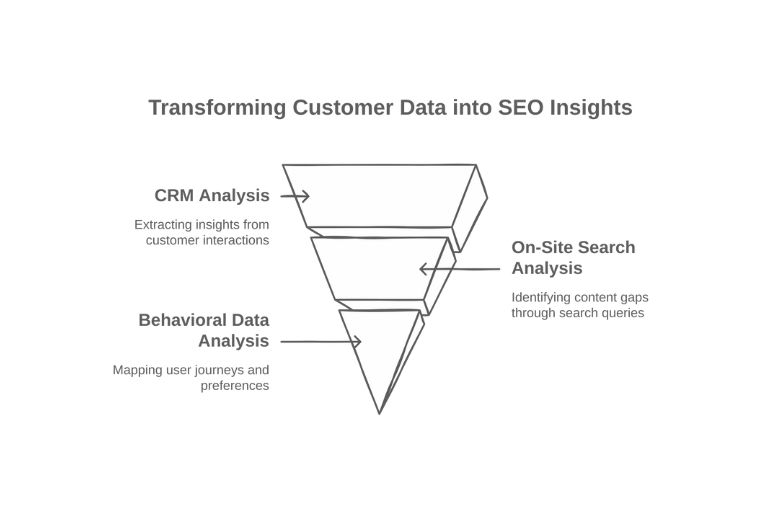
- Mining the CRM
One of the best starting points is your CRM and support channels. These are full of real conversations with genuine discussions and actual customer inquiries, worries, and feedback, all of which reflect what these people are really interested in. When users keep asking how to set up a feature or to connect it with a tool like Salesforce, they are not only indicating a need for you but are also giving you the exact terminology they use to refer to it. Those phrases can serve as the foundation for content that is both search friendly and familiar to the audience.
- On-Site Search Analysis
Another insight can be gained from your website’s internal search: the very search bar! Each search entered is a clue! If visitors are searching for something and cannot find it easily, it is a content gap. These missed opportunities are usually heavy with intent: topics that perhaps should have received a bit more visibility.
- Purchase & Behavioral Data:
Monitoring users’ behaviors lends more insights into the matter. If a company tracks pages that lead to their sign-ups or content types that users return to, they can start plotting a user journey map. If users tend to read about a certain feature prior to conversion, it makes sense to build more content around that subject. Such observations allow you to align your SEO effort with what truly drives decisions.
The results of using first-party data in this way cannot be ignored. Studies indicate that companies that have successfully implemented these learnings have experienced almost 3 times the revenue increase and observable gains in efficiency. In another instance, a fintech firm redesigned its customer surveys to be more adaptive by posing smarter follow-up questions. The outcome was improved learning, enhanced customer experience, and increased retention.
Read: The Role of Proxies in Maintaining Online Privacy and Efficiency
2. Creating Resonant Content That Ranks
Understanding what your audience wants is powerful, but it only truly becomes valuable when you apply that knowledge to influence the kind of content your audience will find. And that is where the change of emphasis should be made, not on assembling information, but on doing something with it. Your customer data is no longer an indication of their requirements alone- it now forms the foundation of information that answers their needs in an understandable and persuasive manner.
- From Keywords to Topic Clusters
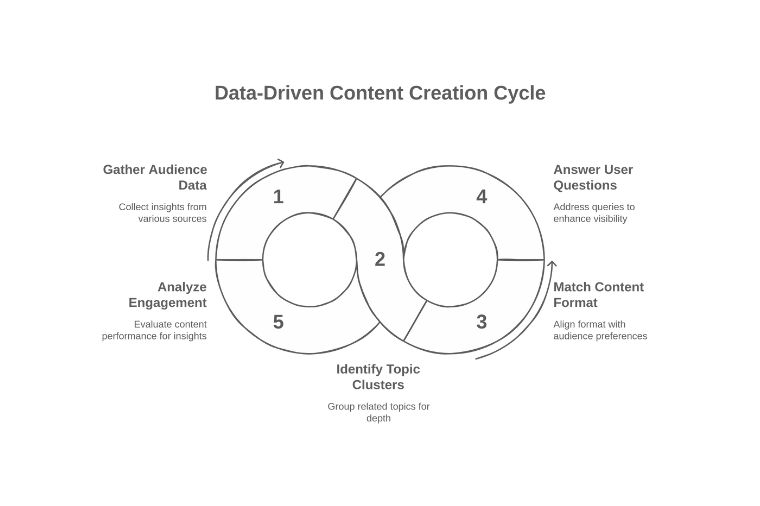
At this point, it becomes apparent that one cannot simply rely on individual keywords. When the customers inquire about certain challenges or features, it is their way of indicating a direction that one needs to follow regarding some wider aspects to hold. Here is where the topic clusters come in. You do not need to create individual posts; create a central page and you can wrap up the whole picture and back it up with subtopic articles. This also assists the search engines to know how deep your content is and also enables readers to have a marked way to follow.
- Content Format Matching:
It is as important what you say, as it is how you say it. We have earlier seen how behavior data can reveal what individuals are searching and going back to. The same behavior can structure the decisions concerning content format. In case users read blogs and pursue further entries by videos or downloads, develop your content to fit those patterns. A video may be the most successful format of a guide. A case study may prove handy as a PDF download. Once the format is appropriate to the audience, the engagement is bound to increase.
- “People Also Ask” Proactive Answering:
And there are the questions. The most proficient content ideas can be made from those that have been detected in chat logs, internal search, and CRM notes. By answering them directly, you stand a better chance of appearing in the Google People Also Ask section. Such small interactions can provide valuable visibility and demonstrate that your content is based on the actual user interest.
This data-driven content approach is already in effect in top organizations. According to a recent global survey by Canva, teams that guided storytelling with data recorded an increase in engagement. When content is personalized, individuals tend to peruse and associate with it.
Netflix is a prime example. Decisions regarding its original content are based entirely on what people are watching or rewatching and where they are pausing. This means shows can be created with an audience of sorts already built-in, which guarantees they will generate high interest and search interest.It is a smart use of behavior data to guide content that works.
3. Tailoring the Search Experience
The next logical step after creating content that truly connects with the audience is to ask what happens next? What do users actually see when they click through from a search result? This is where it gets very interesting. Because while the content helps get the click, the subsequent experience decides whether they will stay or not. And that experience is surprisingly personalized with the help of first-party data.
- Dynamic Content on Landing Pages:
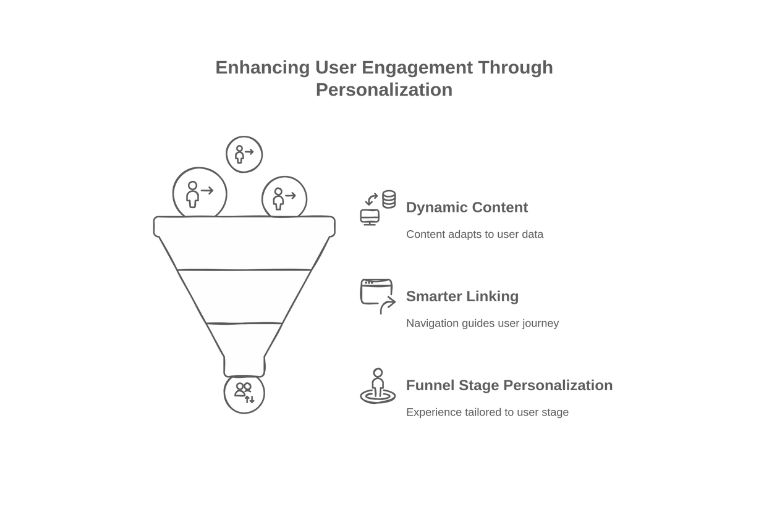
Suppose a visitor arrives at your site. They have not been there until now, but perhaps your CRM can inform you that the visitor belongs to the education sector or has visited a product page recently. Those clues can be used to alter what they observe discreetly. It can be a headline that appeals to their line of business, or a case study that is particularly close to them. You can go as far as to automate this using conversion rate optimization platforms(CRO) which will take what you know about a user and use it to shape the content they see in real time.It’s like giving your site a little bit of intuition.
- Smarter Internal Linking:
The same goes for the internal links. If a person has been browsing a particular topic, they can be quietly directed toward content that builds upon it. It feels like the site understands the user without being pushy and helps create intuitive navigation for users to explore more. The longer they stay and interact, the stronger the signal you give to search engines.
- Personalizing for the Funnel Stage:
And then there is timing. When a returning customer visits your homepage, they do not require as much introduction as first-time visitors. They may like a fast update or a shorter cut to something new. This is when personalization tools discussed above can truly help. They can assist in personalizing the encounter depending on the stage a person is at in their journey as a new or long-time member of your ecosystem.
All of this has a clear payoff. Studies show that personalized experiences can not only increase the feelings of subjective connection among people but also bring about greater performance outcomes. Apart from good engagement and conversion rates, signals can be generated that convey to search engines the worthiness of ranking your content.
Grammarly probably has the best example among these. It simply asks the user a question about his or her identity upon registration. Students are provided with materials tailored toward academic writing. Business professionals receive tools for workplace communication. That little detail influences the user’s whole experience on the site. It nurtures relevance and keeps customers coming back.
4. Amplifying Reach
Now that your website is no longer impersonal with thought-provoking ideas, the next question will really be about how that value can be shared. Until now, the talk has all been about what’s happening on your site. First-party data, of course, opens up all sorts of other doors that help your brand show up in all the right places and reach more people through more intelligent link-building and outreach.
Data-Driven Storytelling
Data can be used in powerful ways, especially in storytelling. But not just any story; in this case, the story must be based on real trends and behavior that you are already observing. Internal data can indicate the very things your audience is most interested in. When formed into some kind of report or visual summary, it becomes the kind of content that people really want to use as a reference. An e-commerce brand might share an annual buying trends list. A SaaS company might publish studies on user behavior. This type of content draws in links naturally.
Identifying Strategic Partnerships
Your data may also identify potential partners. By investigating what tools and communities your best customers are involved with, you can find partnership opportunities. These are places your audience already frequents, which facilitates making the relevant connections that increase visibility and shared credibility.
Guest posting works the same way. Rather than casting a wide net, you can target specific industries or roles with customer data and pitch the content to the platforms where they reside. It feels more directed and effective because it is based on customers’ actual preferences.
The advantage of this approach is that it provides value. Posts based on credible data apparently attract more links and mentions. Backlinko’s study on link-generation methods revealed that original research generally outperforms typical articles in garnering backlinks. It is understandable. People tend to share insights that feel fresh and are grounded in something real.
An excellent example is Spotify Wrapped. Every year, Spotify brings the magic of personal experience to its users through raw data. What adds fun for the users eventually transforms itself into a world fab digital event getting massive media coverage and shares. It all begins with their already available data and ends by creating thousands of high-quality backlinks.
5. Measuring, Refining, and Proving ROI
Once your reach is widened through data storytelling and partnerships, the next step becomes understanding what actually works. This is where the feedback loop comes into play. First-party data allows marketers to deliver what is beyond impressions or clicks. This attaches to what matters such as conversions, lead quality, and customer lifetime value.
The more you segment users, based on what you know, like the comparison between high-value and new visitors, the more specific conditions you can find in behavior that indeed show what works and how. These insights make content performance clearer and drive future efforts with the utmost confidence.
You can refine your strategy easily when it’s backed by facts. If a certain blog post or tool has been proven to possibly inspire people to make a purchase. In that case, it is evident that this should be followed up. There is a reason why the companies that proactively use their data get higher revenue growth and better marketing efficiency: data drives decisions.
Conclusion
First-party data has proven to be the ultimate source of credibility to ensure SEO success. It gives SaaS marketers the ability to create ever-more relevant content, improve user experience, and ensure measurable results. From customer insight to content shaping and personalizing the journey, every step reinforces the belief that rigorous audience knowledge equals stronger performance.
The true advantage lies in using the data not only for reporting but for being a strategic growth driver. Just getting started with something like on-site search or support tickets will begin to shine light on some valuable patterns. Over time, with these insights as a foundation, teams can build out an SEO strategy that is more resilient and effective in growing with its audience for long-term impact.
Author’s Bio:
Vidhatanand is the Founder and CEO of Fragmatic, a web personalization platform for B2B businesses. He specializes in advancing AI-driven personalization and is passionate about creating technologies that help businesses deliver meaningful digital experiences.